When intelligence stops being scarce.
The advantage may be the ability to learn.
September 9, 2026

For most of modern organisational history, intelligence has been relatively scarce.
- Expertise took years to develop.
- Research took time.
- Analysis required people.
- Software required specialist skills.
Knowledge often sat with a small number of individuals who could only be in so many conversations at once. So we built organisations around allocating and coordinating those scarce resources.
Management layers. Reporting cycles. Approval processes. Functions. Meetings. Handovers.
None of those things is inherently wrong. They emerged for good reasons. But AI is starting to change some of the constraints they were designed around. Research that once took days can sometimes happen in minutes. People without traditional software backgrounds can increasingly build working prototypes. Knowledge can be made available across a team without an expert personally answering every question.
That doesn't mean intelligence has suddenly become free. Nor does it mean human expertise matters less. But some forms of cognitive work are becoming significantly more abundant. And when something moves from scarcity towards abundance, it is worth asking what else might begin to change around it.
We tend to meet new technology with old mental models.
There is nothing unusual about this. Some of the earliest cars looked remarkably like horse-drawn carriages with engines attached. Early television borrowed heavily from radio. We tend to take what we already understand and apply the new technology to it. Only after repeated use do we begin to understand what is natively possible. AI may be following a similar path. Much of its value today appears at the level of the individual task.
Draft this faster. Summarise that meeting. Analyse this document. Write this code. Prepare for this customer conversation.
Those gains matter. But they raise another question:
What happens to the system around the task?
If an account manager can prepare a proposal in 20 minutes rather than 2 hours, that is useful. But if that proposal still waits 2 days for pricing, legal review and approval, the customer may experience very little difference. The task improved. The system didn't necessarily improve with it.
Sometimes the bottleneck simply moves. That is why we think there is value in widening the aperture beyond individual productivity and asking what AI might mean for the design of work itself.
People may already be ahead of the organisation.
There are some interesting signals emerging here.
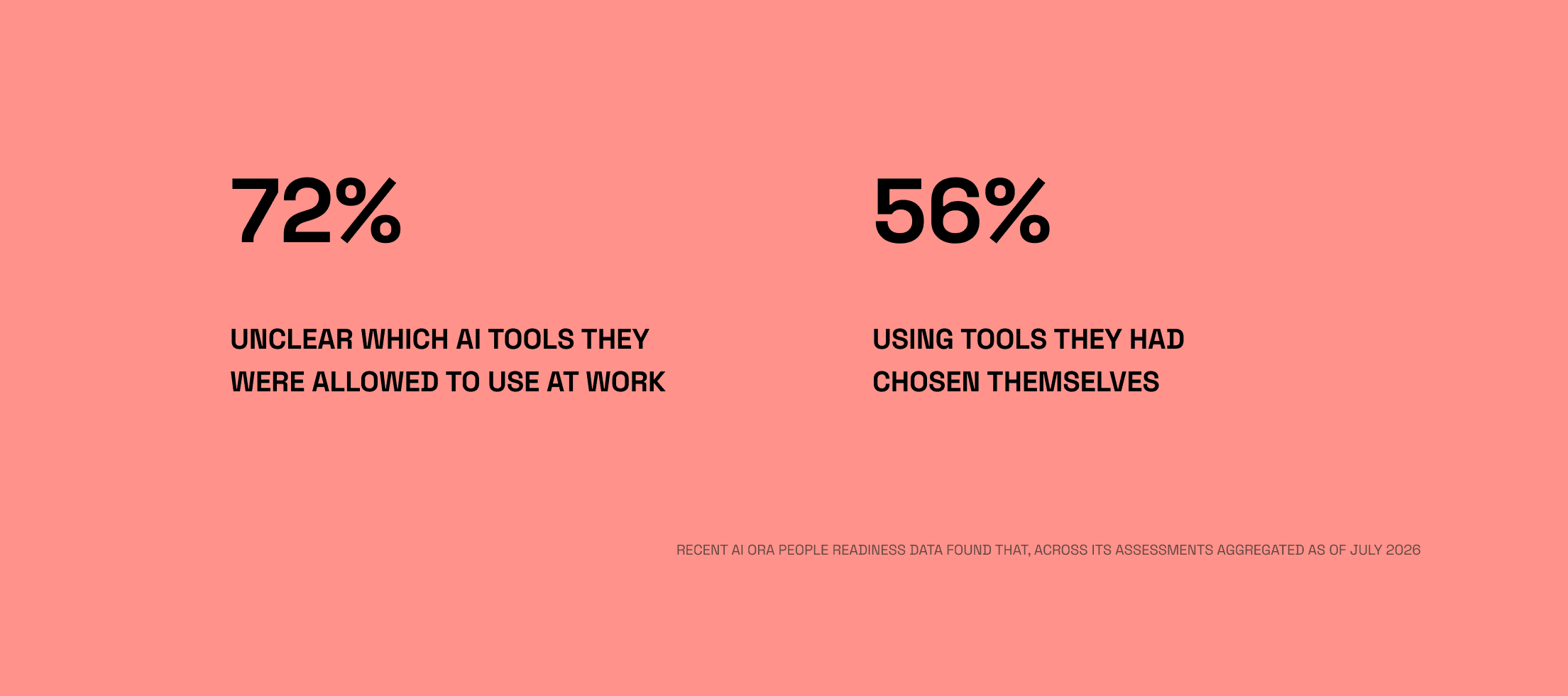
Recent AI ORA People Readiness assessment.
Recent AI ORA People Readiness data found that, across its assessments aggregated as of July 2026, 72% of employees assessed were unclear about which AI tools they were allowed to use at work.
Among employees already using AI at work, 56% were using tools they had chosen themselves rather than tools provided by their employer.
We don't read those numbers as evidence that employees are doing something wrong. They suggest something more interesting.
Behaviour may be moving faster than organisational clarity.
People are experimenting. They are finding tools. They are changing pieces of their own work.
In some cases, they may be discovering different ways of working before the organisation has developed the language, governance or mechanisms to understand what is happening. That creates a different leadership question.
Not simply: how do we get everyone to adopt AI?
But perhaps: how do we build an organisation that gets better at noticing where AI is creating value?
That question changes the shape of the response.
What if the capability is not choosing the right use cases?
There is a lot of sensible work happening around identifying high-value AI use cases. That can be exactly the right starting point. But there is an assumption underneath it worth exploring:
Do we already know where the most valuable opportunities are?
Sometimes we will. Sometimes the people closest to the work may see something leadership cannot yet see.
- The finance person who has quietly redesigned part of month-end.
- The salesperson who has changed the way they prepare for customer meetings.
- The operations team discovering that information previously spread across 3 systems can now be brought together.
- The designer building something that previously needed a development sprint.
Not all of these experiments will matter. Some will simply make an individual task easier. Others may reveal something much bigger about how a workflow, product or service could operate. The organisational capability, then, is not only the ability to execute an AI strategy.
It is also the ability to sense, interpret and learn from what is emerging across the organisation.
Instead of trying to predict every valuable application from the beginning, we can build organisations that become progressively better at finding them.
Leadership. The Crowd. The Lab
One mental model we have found useful at Seen Ventures is to think of the organisation in 3 interconnected parts: Leadership, the Crowd, and the Lab.
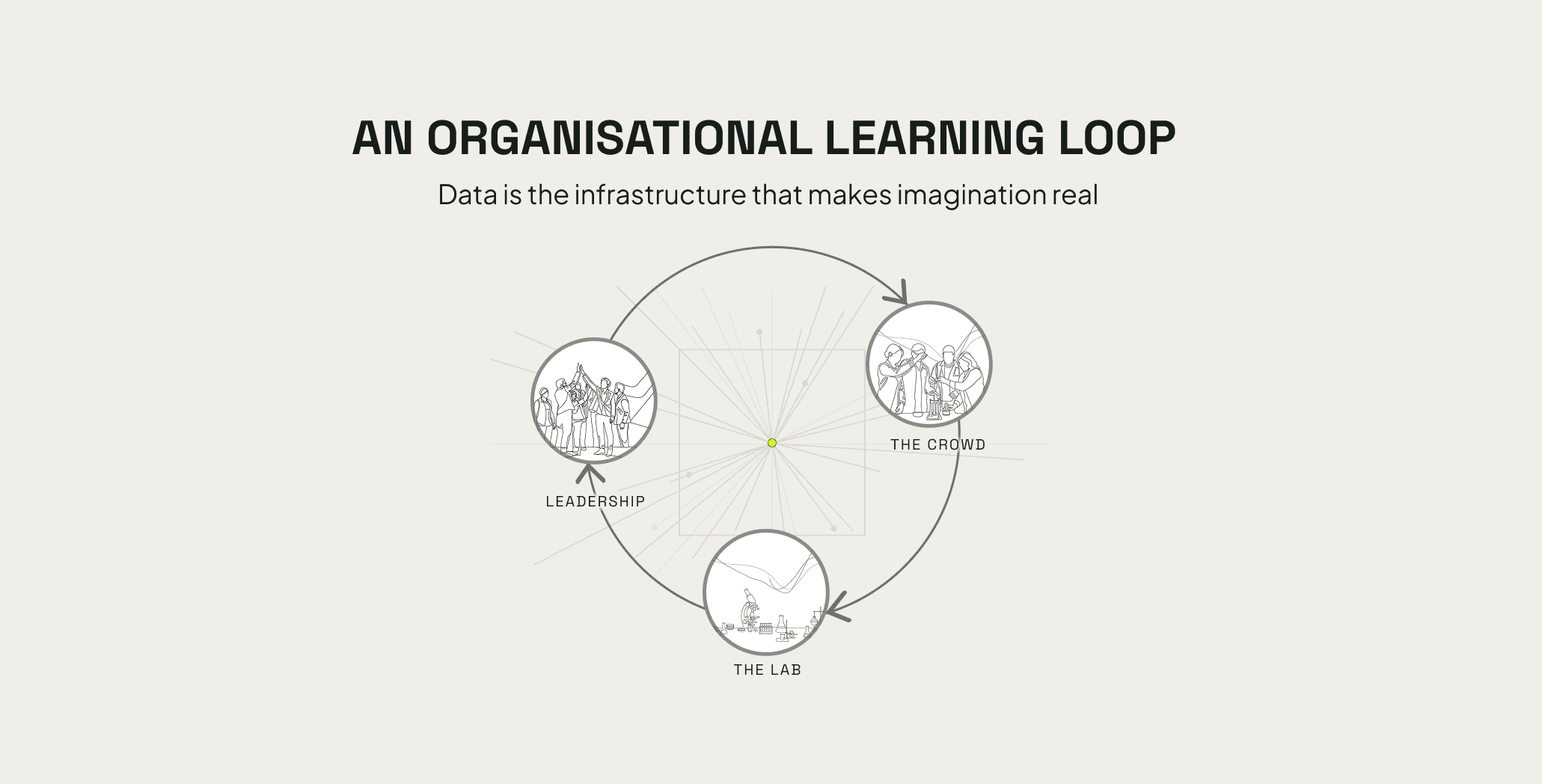
An organisational learning loop connecting Leadership, the Crowd and the Lab. Adapted from Ethan Mollick's framework in "Making AI Work: Leadership, Lab, and Crowd" (2025)
They are not really 3 stages of a programme. We think of them as parts of a learning system. Leadership creates direction and permission. Leaders do not need to have every answer or become the organisation's best prompt engineers. But they can create clarity around the things that matter.
- Where are we trying to go?
- What outcomes matter?
- What are we prepared to explore?
- Where are the boundaries?
- What might now be worth questioning?
Without direction, experimentation can become disconnected activity. Without permission, people may experiment quietly or not at all. The goal is to give people enough context to recognise something valuable when they encounter it.
The Crowd develops the sensing capability.
The people doing the work see things leadership cannot. They experience the handovers. They know where customers become frustrated. They know which spreadsheet exists because 2 systems do not talk to each other. They know which 3-hour process everyone accepts because "that's how we've always done it."
Building practical AI capability across the workforce allows more people to explore those moments themselves. This is not about turning everybody into an AI specialist. It is about helping more people become curious enough, capable enough and confident enough to ask:
Could this work differently now?
The opportunity is not to control that curiosity. It is to learn from it.
The Lab turns signals into something repeatable.
Not every experiment should become an organisational initiative. The Lab gives promising signals somewhere to go.
- Which patterns keep appearing?
- Which opportunities affect an entire workflow rather than one person's task?
- Which connect to strategy?
- What needs to be tested?
- What can be measured?
- What might become repeatable?
An experiment becomes a pattern. A pattern becomes a prototype. A prototype can become a workflow, product, playbook or capability.
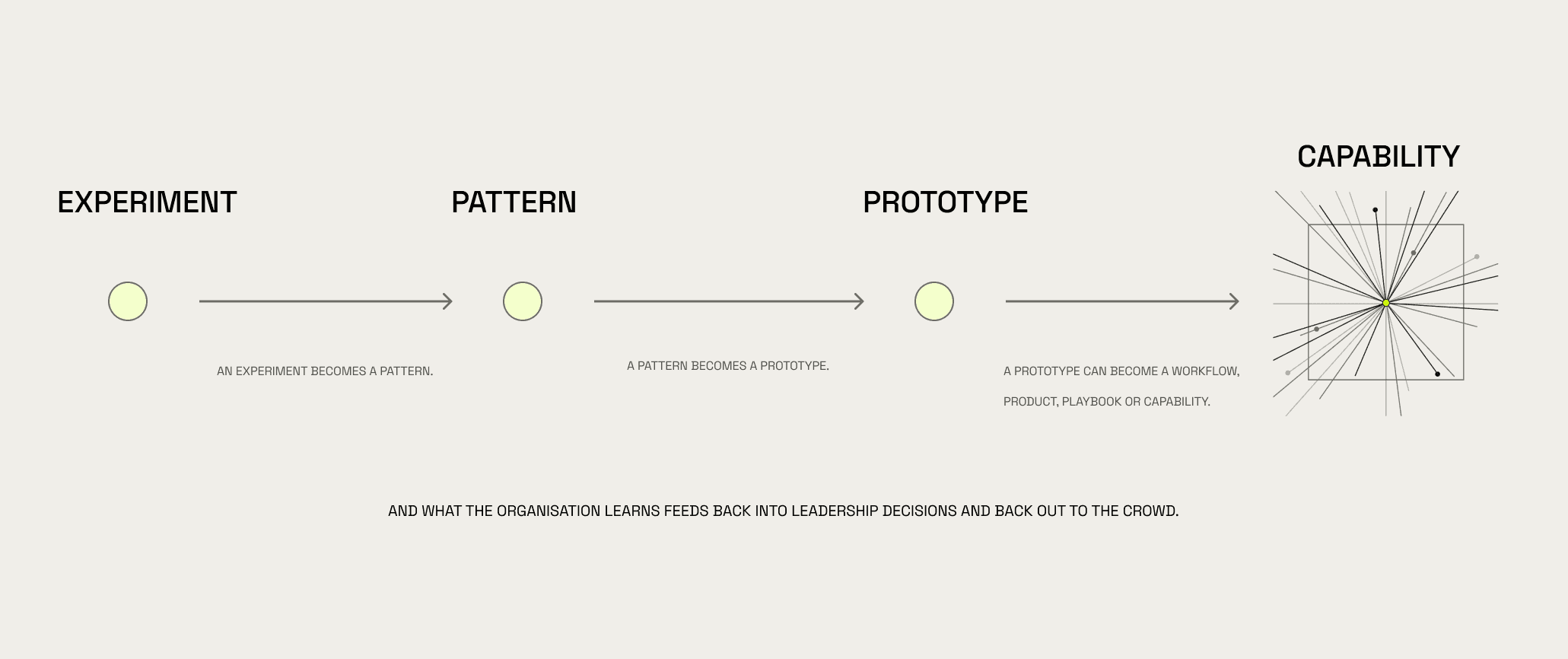
The Lab turns signals into something repeatable
And what the organisation learns feeds back into leadership decisions and back out to the Crowd. Leadership creates direction. The Crowd explores the adjacent possible. The Lab turns the strongest signals into proof. Then the organisation learns. And the loop begins again.
The measure may be whether we are getting better at this.
There is another implication. If AI capability keeps changing, our response probably cannot be a one-off strategy exercise either.
- The questions will move.
- People's capabilities will move.
- New behaviours will appear.
- Governance will evolve.
Things that seemed improbable 6 months ago may become fairly ordinary. So perhaps the more useful question is:
Are we getting better at this?
Are people becoming more confident? Do they understand the boundaries? Can they recognise opportunities in their own work? Is knowledge moving between teams? Are useful experiments being surfaced? Is leadership learning from what people are discovering? Are individual gains beginning to create organisational value?
This is where ongoing benchmarking can become particularly useful. Not as a score to achieve once. But as a way of making an otherwise fairly invisible capability visible over time.
AI ORA's People Readiness research gives leaders one view into what people are actually experiencing, rather than simply what a strategy says should be happening. Revisiting those signals over time can help organisations see whether capability, confidence and clarity are moving with their ambition.
Because strategy in an environment like this may be less of an annual event and more of an ongoing conversation between what we intend to do and what we are learning from reality.
The advantage may be the ability to learn.
We do not know exactly what AI will be capable of 3 years from now.
- Models will change.
- Interfaces will change.
- Costs will change.
- Capabilities we currently consider remarkable may become ordinary.
Trying to perfectly predict that future feels difficult. Building an organisation capable of responding to it feels more practical. One that helps people see what is becoming possible. Gives them room to explore. Surfaces what they discover. Turns promising signals into proof. And feeds those lessons into the next decision.
When intelligence starts to become less scarce, the interesting question is not only what AI can do. It is what we learn to do differently around it.
And perhaps one of the most useful capabilities an organisation can build right now is simply this: getting better at discovering what to do next